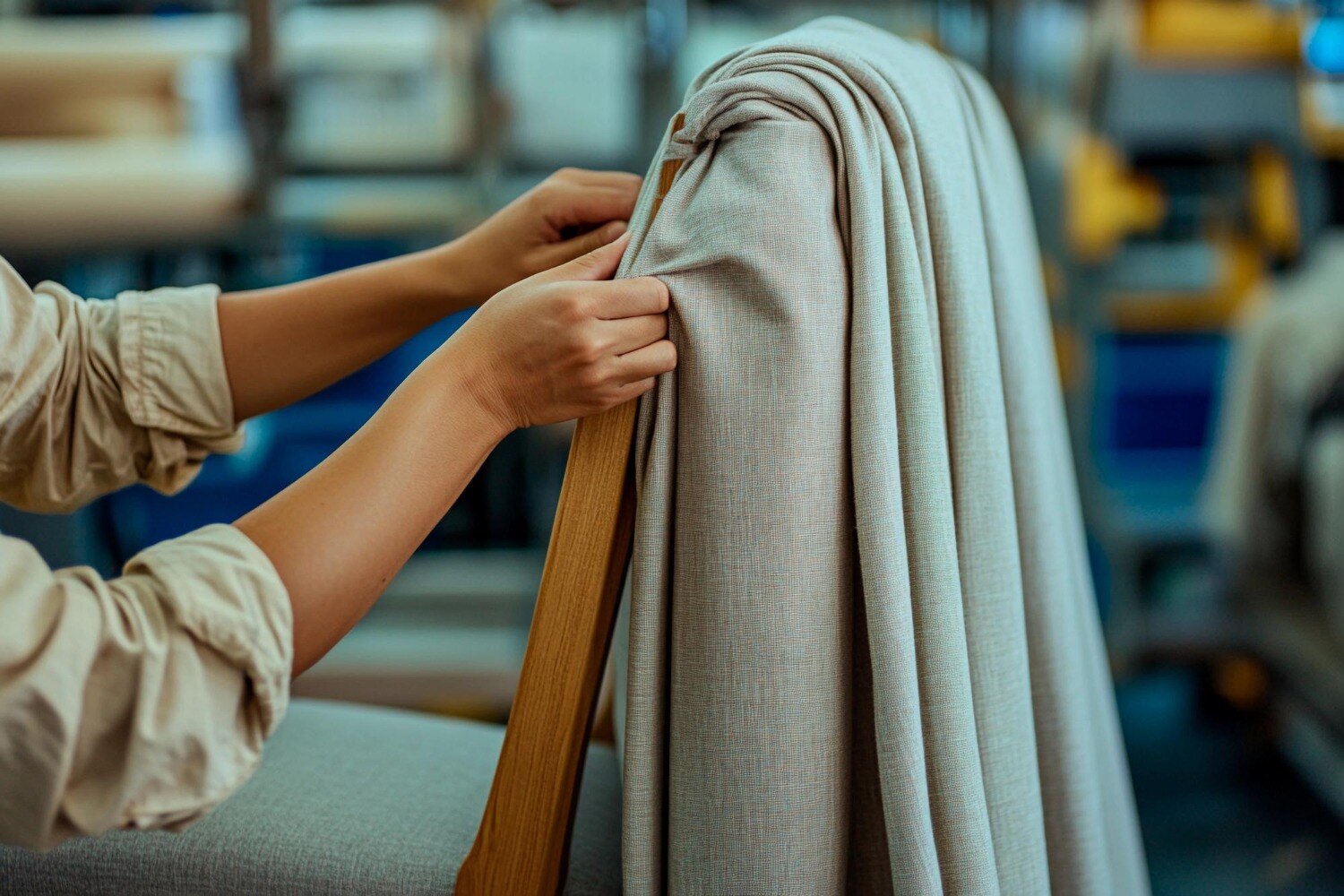
A curtain manufacturer may control the fabric, sewing, finishing and installation—or may outsource several of those steps while presenting itself as a custom supplier. By checking the production process, testing evidence, finished specifications and quotation line by line, you can distinguish genuine made-to-measure work from altered ready-made panels and choose a supplier suited to your windows.
Key takeaways
- Ask who controls fabric, cutting, stitching, finishing and quality checks.
- Test fabric weight, opacity, seams, hems and lining before ordering.
- Confirm custom measurements, tracks, headings and solutions for awkward windows.
- Compare itemised quotations with safety evidence and installation responsibilities.
What a Curtain Manufacturer Does—and What Other Suppliers Do
A curtain manufacturer controls the product specification and production, even when it outsources weaving or some fabrication. It should explain the fabric source, composition, width, lining, cutting, stitching, finishing and quality checks, then identify who measures and installs the finished window treatment.
| Role | What it usually does | What you should verify |
|---|---|---|
| Curtain manufacturer | Develops or controls the specification and fabrication | Ask for fabric and lining details, cutting and stitching standards, inspection records, and responsibility for defects |
| Curtain retailer | Sells products made by other companies | Ask for the actual maker, fabric collection, dye-lot process and warranty terms |
| Curtain reseller | Passes another supplier’s product to you, often with limited production control | Request the original manufacturer’s name and written specification |
| Curtain tailor | Cuts and sews to supplied measurements, but may not source or test the fabric | Confirm who selected the fabric, tested it and guarantees shrinkage or colourfastness |
| Interior designer | Develops the visual scheme and coordinates suppliers | Ask which company manufactures, supplies and installs each component |
| Installer | Measures, fits and commissions tracks, poles or motors | Confirm whether measurement errors, unsuitable headings and operating problems remain covered |
A genuine manufacturer answers technical questions without hiding behind “made to measure.” It identifies the heading, finished dimensions and included components, and explains whether installation is included. Treat universal energy-saving claims cautiously: thermal performance depends on glazing, frame leakage, gaps, lining, fit and whether the curtain is closed.
For motorised curtains, request the weight limit, track length, power supply, controls, override and service access.
The Production Checklist: From Fabric Selection to Quality Control
Approve a supplier only after the written specification names every component: face fabric, lining, interlining, heading, track or pole, brackets, returns, holdbacks, motorisation, delivery and installation. A price per metre can hide missing hardware, inadequate fullness or installation charges.
- Ask for fabric sourcing details, composition, fabric width, GSM or weight, and whether the cloth is produced by weaving or knitting. Record colourfastness, rubbing resistance, pilling, seam strength and dimensional shrinkage results.
- Confirm cutting, stitching and finishing standards, including seam allowances, hem depth, pleat spacing, hook positions, eyelet size and the inspection performed before packing.
- Require care instructions for the face fabric, lining, interlining and hardware separately. “Washable” is incomplete without the permitted process, temperature and dimensional tolerance; heat and steam can alter coatings, pleat retention and flame performance.
- Treat thermal performance as a system claim. Ask for the test basis or calculation and check whether it accounts for glazing, frame leakage, curtain-to-wall gaps, fit and closed-curtain operation.
- For motorised curtains, verify maximum curtain weight, track length, power or battery arrangement, controls, obstruction response, manual override and service access.
Heading choice changes appearance, clearance and hardware compatibility:
| Heading | Specification to verify | Main consequence |
|---|---|---|
| Wave or ripple | Compatible track and carrier spacing | Needs controlled folds and stacking space |
| Pinch or goblet pleat | Fullness ratio and stack width | Uses more fabric and creates deeper folds |
| Eyelet or pole heading | Pole diameter, bracket position and returns | Must move over the pole, not around standard brackets |
Have the supplier confirm the finished width, drop, fullness ratio and installation responsibility before approval.
How to Test Curtain Quality Before You Place the Order
A fabric swatch predicts appearance, but a sewn sample reveals construction. Inspect both, then compare them with a written specification before approving the order.
1. Hold the fabric swatch against daylight and indoor light. Check colour consistency, weave density, the selvedge, reverse side, surface flaws and the stated fibre composition. Ask for GSM, colourfastness results, rubbing resistance, pilling grade and shrinkage tolerance; vague terms such as “premium” prove nothing.
2. Examine the sewn sample from face to lining. Look for straight seams, secure thread, an even hem, consistent pleats or waves, clean joins and hooks or eyelets that suit the proposed track or pole. Open the layers: the lining and interlining should be identified, attached evenly and free from puckering.
3. Read care instructions for the face fabric, lining, interlining and hardware separately. “Washable” is incomplete unless the specification names the permitted washing or dry-cleaning process, steam and heat limits, and dimensional tolerance; unsuitable treatment can change the drop, damage coatings, flatten pleats or affect flame performance.
4. Check the written specification for finished width and drop, fullness ratio, panel joins, lining, heading, track or pole, brackets, returns, holdbacks, motorisation, delivery and installation. Fullness affects fold depth, fabric weight and stack space, so do not accept a ratio without confirming it suits the heading and fabric.
For commercial work, request the finished assembly’s flame-performance evidence, cleanability, replacement-panel method and maintenance access. “Fire retardant” on a domestic label does not prove compliance with the building’s occupancy requirements or fire strategy.
What Genuine Customisation Covers for Difficult Windows
A genuine manufacturer handles difficult windows by measuring the opening and designing the complete curtain system, not by cutting standard panels to a requested width. For bay windows, angled corners, arched heads, deep reveals, or windows interrupted by radiators, request a drawing showing each section, joins, clearances, stack positions and the proposed track or pole.
The quotation for made-to-measure curtains should identify every component included:
- Fabric, lining and interlining
- Finished width, drop, hem and side allowances
- Heading style, curtain fullness ratio and panel split
- Track or pole, brackets, returns and holdbacks
- Motorisation, controls, delivery and installation
Confirm how the curtain fullness ratio is calculated: finished fabric width divided by track or pole width. A ratio around 1.5:1 uses less fabric and stack space, while ratios approaching 3:1 create deeper folds but add weight, cost and hardware demand.
The manufacturer must match the ratio to the fabric and heading rather than apply one default.
Heading style affects both appearance and movement. Wave headings need compatible tracks and carrier spacing; pinch pleats consume more fabric; eyelets need a pole that allows the panels to pass the brackets. A vague “custom size” label does not prove compatibility.
Before production, the installer should check whether walls, ceilings or lintels can carry the hardware, whether uneven surfaces need packers, and whether furniture, radiators, sockets or window handles obstruct movement. Record these conditions on the survey, along with curtain-to-wall gaps and access for future maintenance.
A poor fit can defeat light control and thermal performance even when the sewing is excellent.
How to Compare Quotations, Safety Evidence and the Finished Installation
Compare suppliers against the same window measurements, fullness, heading style, lining, hardware, delivery and installation scope. A low price per metre can omit the track, returns, brackets, interlining or fitting. Ask each manufacturer for an itemised curtain quotation naming fabric, lining, blackout lining, heading, track or pole, holdbacks, motorisation, delivery and installation.
| Compare | Require | Reject |
|---|---|---|
| Specification | Exact fabric, dimensions, fullness, seam layout, lining and hardware | Vague “made to measure” wording |
| Safety evidence | Test report for the required edition of NFPA 701 on the proposed drapery | “Fire retardant” label without a report |
| Performance | Test basis or calculation for thermal performance and blackout target | Universal energy-saving or blackout percentages |
Treat thermal performance as a system claim. Glazing, frame leakage, curtain-to-wall gaps, lining, fit and whether the curtain stays closed all affect the result. Near-darkness also requires control of seams, hems, returns, top gaps and the space below; a recessed track, overlap and pelmet may matter more than a darker face fabric.
For a commercial project, check cleanability, dimensional stability, replacement of individual panels, maintenance access and alignment with the building fire strategy. NFPA 701 measures flame propagation; it does not make fabric permanently fireproof. Request care instructions stating washing or dry-cleaning method, steam and heat limits, and dimensional tolerance.
At handover, measure finished width and drop, inspect pleats and hems, test every carrier, bracket, cord or motor, and close the curtains in daylight. Record defects before accepting the work. Whether you appoint Blinds N Curtains or another supplier, compare the approved specification with the invoice and installation, not just the sample.
Frequently asked questions
What does a curtain manufacturer do?
A curtain manufacturer controls the product specification and production, including fabric selection, cutting, stitching, finishing and quality checks. Ask who measures and installs the finished treatment.
How can you test curtain quality before placing an order?
Inspect a full-size sample or finished sample for fabric weight, opacity, colour consistency, straight seams, even hems, secure hooks and correctly attached lining.
What does genuine curtain customisation cover?
It covers precise window measurements, fabric and lining choices, heading style, track or pole dimensions, drop length, returns, corners, bay windows and other difficult shapes.
How should you compare curtain quotations?
Compare itemised fabric, lining, making, hardware, measurement, delivery, installation, taxes and aftercare costs. Check the quotation also identifies safety evidence and each party's responsibility.