The right blind depends on more than the glass area: recess depth, handle projection, opening movement, obstructions, and the blind’s own headrail and fabric dimensions all affect the result. By the end, you will be able to measure each window, choose an inside or outside mount, decide whether to split wide openings, and compare blind styles against the way each room is used.
Key takeaways
- Choose inside mounting only when the recess is square, deep and obstruction-free.
- Use outside mounting when a narrow recess would hide too much glass.
- Measure handles, grilles, radiators and nearby doors before selecting the blind.
- Split wide openings into separate blinds for safer operation and easier maintenance.
Match the blind to the window’s size, shape, and movement
A single inside-mounted blind suits standard windows when the recess is square, deep enough for the headrail, and free of handles or locks. Choose outside mounting for narrow windows when preserving visible glass matters, because the blind can cover the recess while making the window appear larger.
| Window type | Suitable configuration | Check before ordering |
|---|---|---|
| Standard window | Single roller, Roman, or Venetian blind | Recess depth, square corners, and unobstructed operation |
| Narrow window | Outside-mounted roller or slim blind | Required overlap and whether inside mounting hides too much glass |
| Tall windows | Taller-drop roller, vertical blind, or carefully positioned headrail | Stack height, control reach, and headrail position |
| Short windows | Low-stack roller or shallow blind | Folded fabric or slats must not cover excessive glass |
| Unusually wide windows | Two or more coordinated blinds, vertical blinds, or curtains | Maximum width, area, weight, headrail deflection, centre gap, and stack direction |
| Sliding doors | Vertical blinds, coordinated rollers, or curtains | Clear panel movement, floor clearance, and stack-side space |
| French doors | Shallow door-rated blind with hold-down brackets | Handle sweep, sash movement, and swinging when the door opens |
| Casement or tilt-and-turn windows | Low-profile frame-mounted or outside-mounted blind | Handle clearance, tilt path, and full operating sweep |
| Fixed panes | Most blind styles | Mounting depth and desired light control, since no sash needs clearance |
Windows that open inward need space for the sash, handle, and blind stack. Arched, circular, triangular, and other shaped windows often require specialist templates or fixed treatments rather than a rectangular blind.
Treat bay and bow windows as separate intersecting openings: measure each one and plan corner gaps, bracket depth, headrail termination, and clearance from neighboring blinds.
Measure the opening before choosing inside or outside mounting
Measure the recess before choosing an inside mount or outside mount. An inaccurate width can leave a blind jammed in the opening, while an inaccurate height can expose glass or prevent the blind from clearing the sill.
For an inside mount, record:
- Recess width at the top, middle, and bottom; use the narrowest measurement.
- Recess height at the left, centre, and right; use the shortest measurement.
- Sill depth, frame width, handle projection, lock projection, and depth available above the frame.
Check whether the recess is square by comparing the width and height readings. Inspect plaster, tile, sealant, and trim because each can reduce usable depth. Ask for the product’s minimum recess depth and required frame clearance before ordering.
Do not guess a deduction. Some suppliers deduct clearance themselves; others require the exact finished size, so confirm the ordering convention in writing.
| Mounting option | Measurement and ordering | Practical result |
|---|---|---|
| Inside mount | Order using the supplier’s stated convention after recording the narrowest width and shortest height | Preserves the wall line but can expose side gaps |
| Outside mount | Measure the opening, then add the product-specific overlap needed to cover the recess, frame, hardware, and desired light gap | Covers more opening and can make the window look larger, but reduces visible wall or glass |
The visible glass width is not the finished blind width. Roller fabric can be narrower than its headrail and brackets, so use an outside mount or side channels when limiting light leakage matters.
Resolve handles, grilles, radiators, and door-side obstructions
Plot every obstruction on the measurement sheet: handles, locks, security grilles, mosquito screens, radiators, curtain tracks, deep sills, wardrobes, nearby walls, skirting, and adjoining window reveals. Measure each projection from the glass or wall, then mark whether it occupies the blind’s drop, stack, control side, or operating path.
Use this mounting check before ordering:
| Option | Check | Consequence |
|---|---|---|
| Inside mount | Recess depth, squareness, frame clearance, and hardware projection | A shallow or uneven recess can trap the blind or prevent operation |
| Outside mount | Overlap beyond the recess, frame, and hardware | Covers obstructions, but reduces visible wall or glass around the opening |
| Door mount | Handle sweep, headrail depth, and swinging movement | French doors need hold-down brackets or a door-specific design |
| Bay mount | Bracket depth and headrail termination at every corner | Adjacent blinds can collide or leave unusable gaps |
For French doors, leave handle clearance and restrain the blind as the door moves. Check sliding doors for the clear panel stack and track-side control access. Casement windows need clearance for the opening sash; tilt-and-turn windows need both tilt-path and handle-sweep clearance.
In a bay, measure each intersecting opening separately. Horizontal slats or bands emphasise width, while vertical lines suit tall or broad openings.
Check headrail depth, stack height, and control position against radiators, wardrobes, furniture, escape routes, doors, sprinklers, and fire equipment. In commercial premises, keep controls within the intended user’s reach and clear of accessibility routes.
Compare blind styles by clearance, light, privacy, and upkeep
Compare each treatment against the room’s clearance, light target, privacy needs, ventilation, cleaning routine, and moisture exposure—not window size alone.
| Option | Clearance and operation | Light and privacy | Upkeep |
|---|---|---|---|
| roller blinds | Compact recesses and simple operation; check fabric side gaps, cassette depth, and bottom clearance | Filtering or blackout fabric; gaps still admit light | Dust fabric and inspect chain or motor |
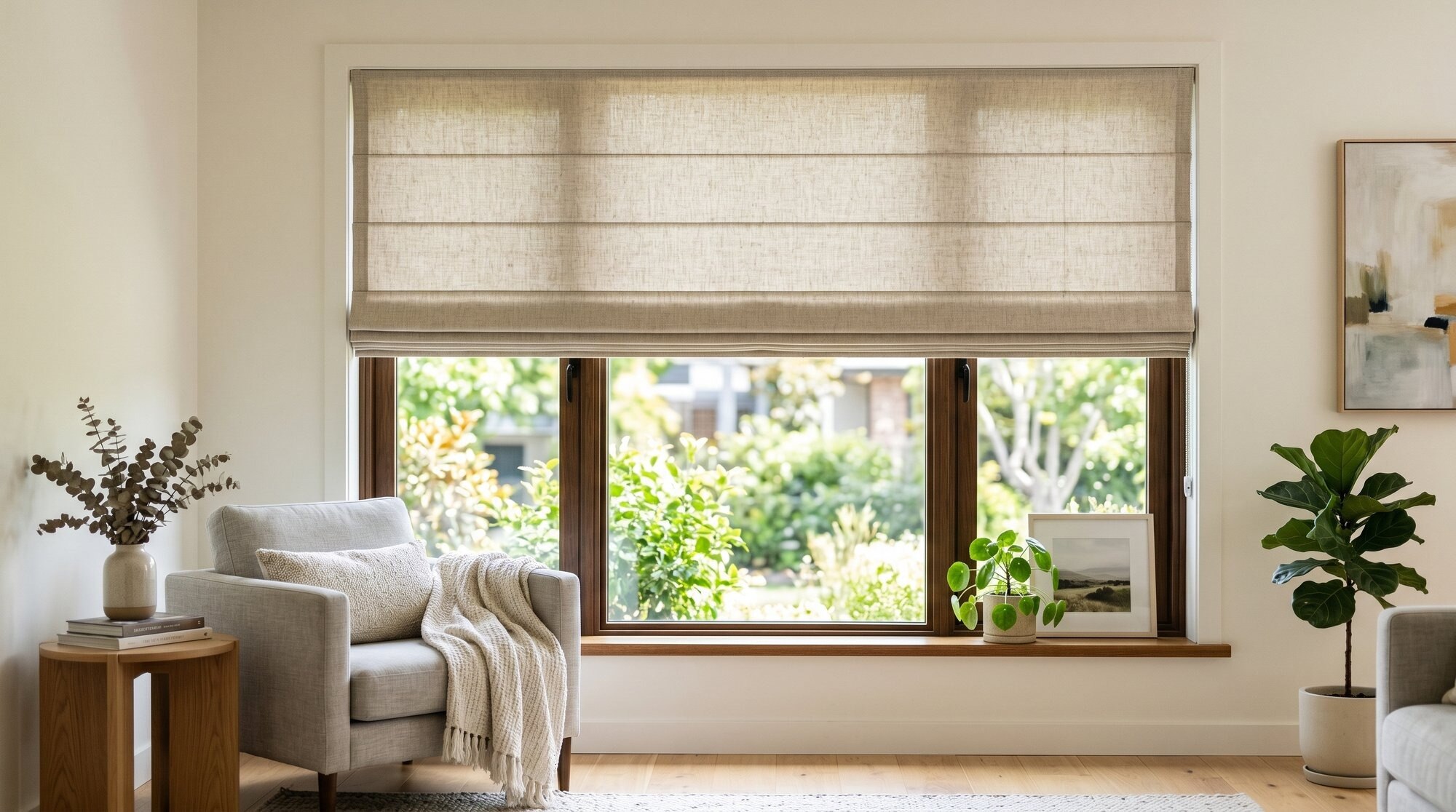
| Roman blinds | Need space above the glass for the folded fabric stack; greater stack height can hide glass | Soft light control and strong privacy when lowered | Fabric needs careful vacuuming or professional cleaning |
| wooden blinds | Rigid slats project into the room; allow extra clearance around handles | Adjustable privacy and glare control | Dust slats individually; moisture can warp untreated wood |
| zebra blinds | Check headrail depth and that alternating fabric bands meet at the chosen drop | Adjustable filtering with changing privacy levels | Dust both fabric layers without snagging them |
| vertical blinds | Suit wide windows and sliding doors; panels need a clear stack side and floor clearance | Panels rotate for glare and privacy control | Vacuum or wipe panels and keep the track clear |
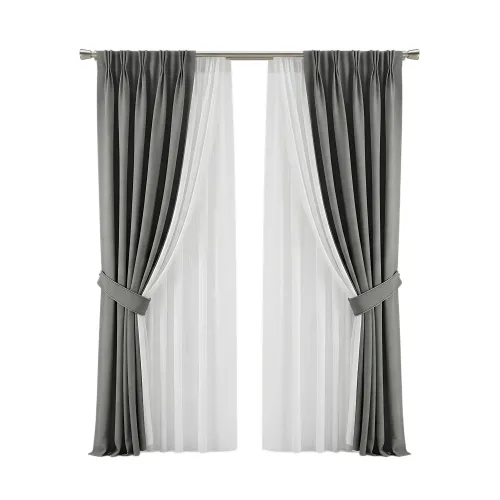
| curtains | Require a full-width track and generous side stack | Softer ventilation and strong privacy when drawn | Wash or dry-clean fabric and dust the track |
For bathrooms, kitchens, and humid commercial areas, compare aluminium, PVC, and specified synthetic fabrics with untreated natural fabrics. Ventilation still matters: condensation can cause mould, staining, and corrosion at brackets and fixings.
For solar control, assess orientation and glazing, not colour alone. Compare U-factor, solar heat-gain coefficient, and visible transmittance where suppliers provide them; exterior shading blocks radiation before it reaches the glass.
A blackout label does not seal side, bottom, cassette, or window-edge leakage. Use recessed side channels or an overlap outside mount when darkness is critical.
Split wide openings and plan a safe, installable finished design
Wide openings should become two or more blinds when the product’s maximum width, area, or weight is exceeded, a single headrail would deflect, or operating force would become excessive. Align every panel at the same height and design the centre meeting gap: it creates a visible line and light leakage.
Multiple chains or motors also add control points and can disturb symmetry.
| Configuration | Check before choosing | Main trade-off |
|---|---|---|
| Two panels | Headrail size, centre gap, stack direction, and sightline | Fewer controls and a cleaner rhythm |
| Three or more panels | Hardware space, repeated gaps, matching heights, and individual stacks | Better load distribution but more visible divisions |
For blackout rooms, use side channels, a close-fitting cassette, or enough outside overlap; dark fabric alone cannot block light at the edges. Choose cordless, inaccessible-cord, or motorised blinds in homes with children. If cords remain, tension and anchor loose chains with the specified hardware.
Validate the finished design by checking:
- Motorised blinds have power or battery access, accessible controls, specified obstacle response, stop positions, and commissioning so they cannot strike handles, furniture, or neighbouring blinds.
- Fixings suit masonry, plasterboard, timber, metal framing, or insulated and cavity construction; add reinforcement or a fixing board where the substrate is weak.
- Blinds N Curtains can record mounting depth, obstructions, panel divisions, controls, and fixing conditions in a window-by-window schedule before installation.
Related products
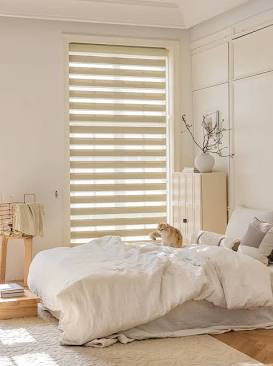 | Zebra Blinds Transform your living spaces with the modern elegance and functional versatility of Zebra Blinds from Blinds N Curtains. View product → |
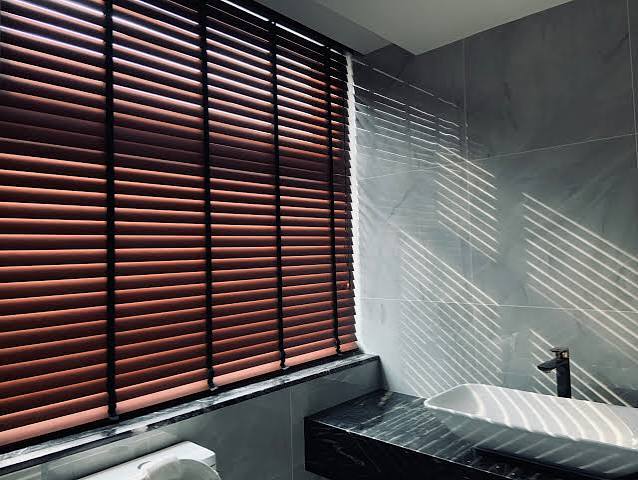 | Wooden Blinds offer a timeless blend of classic elegance and natural warmth, making them an ideal window treatment for both traditional and modern interiors. View product → |
Frequently asked questions
How do I match a blind to my window’s size, shape and movement?
Choose a blind that follows the window’s shape and leaves enough clearance for the sash, casement or sliding panels to open without interference.
How do I measure for inside or outside mounting?
For inside mounting, measure the recess width at the top, middle and bottom, plus its height and depth. For outside mounting, measure the area you want the blind to cover and add clearance beyond the recess.
How do I handle window handles, grilles, radiators and nearby doors?
Record each obstruction before choosing the blind, then allow space for the blind, headrail and operating controls to clear it during use.
Which blind style is best for light, privacy and upkeep?
Compare each style by its stack or roll clearance, light gaps, privacy position, cleaning method and access to the window.
Should I split a wide window into several blinds?
Split wide openings when one blind would be heavy, difficult to operate or unable to clear the window safely. Plan the divisions around mullions and furniture.
Related products
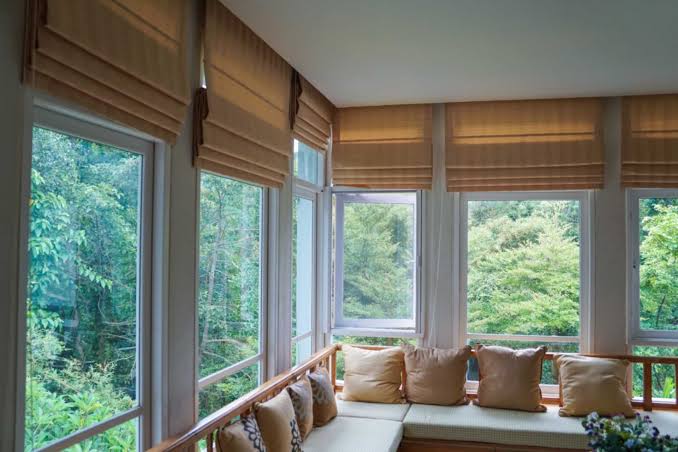 | Roman Blinds Elevate your interior space with the timeless elegance and refined functionality of custom Roman Blinds from Blinds N Curtains. View product → |
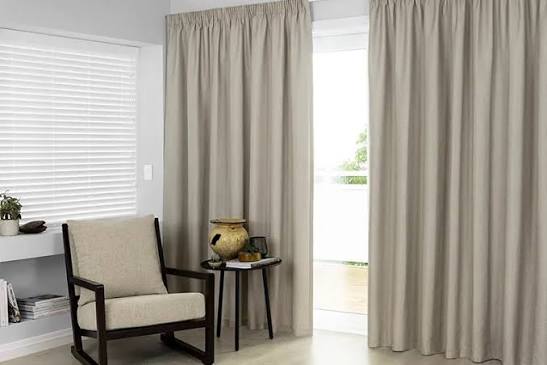 | Thermal Insulated Curtains At Blinds N Curtains, our Thermal Insulated Curtains are expertly designed to transform your home into an energy-efficient sanctuary without... View product → |